

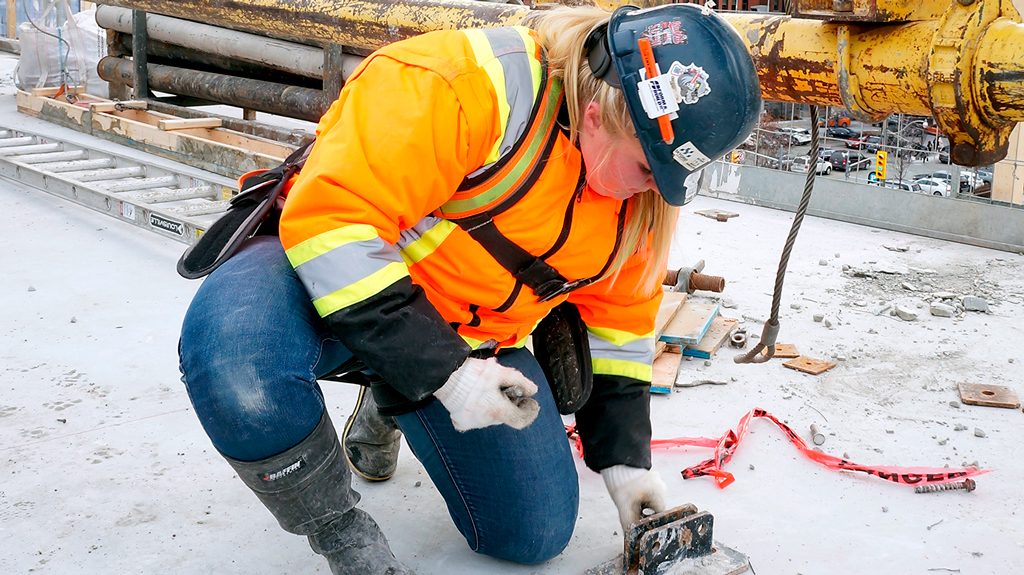
Women are eager to get into skilled trades careers in construction but after completing their pre-apprenticeship program finding an employer to sponsor them can sometimes be difficult.
“They cannot find anyone who is willing to take them on as a Level 1 apprentice,” Emily Arrowsmith, director of research and programs at the Canadian Apprenticeship Forum, told a recent Women in Construction webinar hosted by the Residential Construction Council of Ontario.
“We know that’s a challenge across 17³ԹÏÍø. That means if you can’t get registered you can’t start your journey as an apprentice.”
Arrowsmith was part of a panel with Shaily Allison, manager of marketing and engagement at BuildForce 17³ԹÏÍø, and Lisa Pryce, assistant director of the LIUNA Local 183 Training Centre. The event was hosted in partnership with the Ontario Residential Council of Construction Associations.
Arrowsmith told the audience she’s been interviewing women in the GTA who’ve completed pre-apprenticeship programs and found there isn’t a supply problem as women want to get into the trades. The number one problem appears to be that they can’t find an employer sponsor.
The other problem is that bullying and harassment are still an issue for women on construction jobsites.
“Women apprentices are more likely to report mental health challenges than men and they’re more likely to report having depression and anxiety and being on some kind of prescription for their depression and anxiety,” said Arrowsmith, “and it does relate to how they’re treated at the workplace.”
Figures show recruitment of women in the skilled trades has risen across both Ontario and 17³ԹÏÍø, especially among young women, and they now represent about five per cent of all onsite tradespeople in Ontario. However, the stats also show retention is a major issue.
Arrowsmith said the stats show men still dominate the apprenticeship training system in 17³ԹÏÍø, with 89 per cent of new apprentices being men and 11 per cent women. In Ontario, 88 per cent of those enrolled in apprenticeships were men while 12 per cent were women.
As for completions, the stats show that, historically, fewer women than men complete their training programs.
“This is concerning because it means that these women apprentices are not making it through the program,” said Arrowsmith. “They’re discontinuing their program, and it means they’re not getting their Red Seal. It’s the key to accessing permanent, full-time employment.”

Allison of BuildForce 17³ԹÏÍø said retention of women in the trades has become a major challenge.
“We know that women often cite barriers on the jobsite like mentorship, poor jobsite culture, inadequate facilities and PPE, and the challenge of balancing caregiving with often rigid sitework and commuting. To build a truly sustainable workforce we need to retain those women, we need to improve site culture and support, and we need to leverage new opportunities.”
Allison noted there has been modest but steady growth in the number of women in the industry, especially the residential construction sector, over the past decade or so, and now approximately 13 per cent of the 1.3 million people that work in the industry nationwide are women.
In 2023 and 2024, there were 77,000 to 80,000 women working in Ontario’s construction industry – or 13 per cent of the provincial workforce – the same as the national percentage, she said.
Twenty-six per cent of those women work onsite in skilled trades roles, which amounts to about 20,000 women – so 74 per cent of women working in the construction industry are working in off-site roles in administration, estimating, HR and project management, Allison explained.
For several years, the percentage of women working in the industry onsite hovered around three to four per cent – but in 2023 it jumped up to five per cent.
Women have a higher representation in the residential sector where they make up nearly six per cent of workers and in new home construction the figure is closer to seven.
“The residential industry is really offering a key entry point for women to enter the industry and that’s where we see a lot of women working,” said Allison, noting women are more inclined to work in finishing trades like painting, drywalling and carpentry.
Pryce of LIUNA said retention of women in the industry is difficult due to several factors – one being that they often have children, which can make work life difficult.
However, Pryce has noticed more women at union meetings, which indicates they are playing a bigger role in the workforce.
LIUNA has been particularly active in recruiting women and does a lot of outreach, which includes working with the community, organizations and agencies.
“We know there’s more opportunities out there,” said Pryce. “We just need to keep pushing that agenda, keep recruiting, show women that their presence is valued.”
There’s still a way to go, but Pryce said the situation is improving.
“Even though it’s not where we want it, it’s still getting better. It’s on the uptick as opposed to declining.”






Recent Comments
comments for this post are closed