


17³Ô¹ÏÍø’s housing shortage is calling for increased residential density, particularly buildings in the seven to 12-storey range. Environmental sustainability in their construction is often seen as an added prerequisite. As a result, many project developers may cast their eyes towards all-Mass Timber Construction (MTC) as the solution.
As national and provincial codes begin to allow taller Encapsulated Mass Timber Construction (EMTC) buildings, WoodWorks says designers are now looking at combining mass timber with other structural materials, “to integrate more sustainable and efficient solutions into their projects.�
In fact, switching away from traditional concrete and steel to wood for mid-height construction is not always a difficult transition. Â
As the non-profit advocacy group WoodWorks , many multi-family and hospitality projects have interior wall layouts easily adaptable to Cross Laminated Timber (CLT) floor panels. Most can also use CLT for interior bearing walls, especially when stacked floor-to-floor.
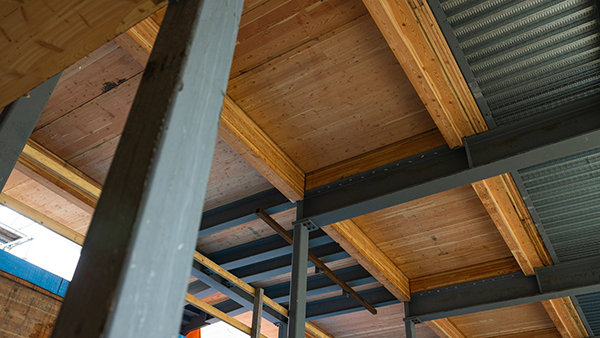
Blending CLT floor and roof panels with cold-formed steel (CFS) stud bearing walls is regarded particularly attractive for mid-height multi-family and hospitality projects. A CLT/CFS hybrid combines the strength and load-bearing capacity of mass timber for gravity loads with the lightweight, adaptable nature of CFS for other structural elements and/or lateral load resistance.Â
The reduced embodied carbon benefit of mass timber is well known. Wood is among the preferred approaches to reducing greenhouse gas emissions, enabling the construction of zero-carbon or carbon negative buildings.
CFS has its own sustainability advantages to offer.
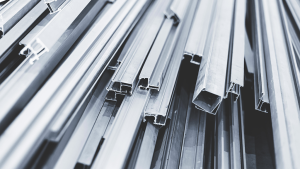
Cold forming shapes steel at near-room temperature by passing it through a series of rollers in order to reach the desired length, profile and thickness. Since no further heat and GHG emissions are required as with hot-rolled steel, CFS skips those associated carbon emissions. CFS end products retain and even enhance the metal’s tensile strength while still allowing high levels of intricate manipulation. Almost two-thirds of CFS is and typically contains a minimum of 25 per cent recycled steel content, and is fully recyclable at the end of its lifespan.
CFS floors and wall panels were adopted into 17³Ô¹ÏÍø’s building codes in 1984 and are increasingly seen in frameworks for residential, commercial and industrial buildings of every size and purpose. CFS systems offer several advantages: they are lightweight and easy to handle, non-combustible, and dimensionally stable.
While taller MTC buildings are now permitted in 17³Ô¹ÏÍø, there are engineering elements that need to be addressed as heights increase.
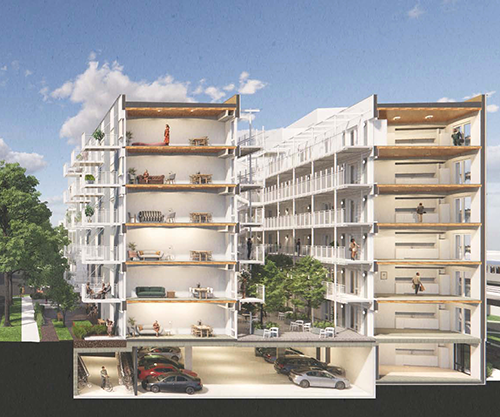
In their detailing the engineering points to be considered in CLT/CFS hybrids, Robert Malczyk and Hercend Mpidi Bita of Timber Engineering in Vancouver write, “The lateral load-resisting system (LLRS) of hybrid mass timber buildings are typically non-wood based. The most common options for LLRS in multi-storey buildings taller than six storeys are concrete shearwalls or cores and steel braced frame.�
These are issues Malczyk and Bita suggest the integration of CFS can address. They also point to simplicity of the CLT/CFS system for building seven to 12 storeys.
“The structural efficiency of the system enables clear, simple, and direct load paths for gravity loads where the forces are transferred from the top or roof level to the lowest levels or foundation through lined-up loadbearing CFS walls. The CFS walls in plan can either be straight or follow the architectural layout, provided they are stacked up at all levels. These direct load-paths provide a cost-effective solution as no transfer elements are required.�
The CLT/CFS system has also been found to be a cost-effective and efficient solution in this height range in a platform-type construction where floor panels are sandwiched between two consecutive single storey walls and thus act as a platform for the next immediate storey.
CFS wall panels meet building code requirements for non-combustible construction. CLT/CFS walls and floors also meet NBCC acoustic standards.
Since CLT/CFS system is composed of repetitive, lightweight, easy to handle structural components, prefabrication off site is possible, followed by quick onsite assembly that minimizes both time and waste. Â
Vienna House, a seven-storey multi-family residential housing project in Vancouver, is currently under construction using the CLT/CFS system, and is scheduled to be completed this November. It is hoped the project will provide baseline information that could be scalable to even taller structures.
John Bleasby is a freelance writer. Send comments and Inside Innovation column ideas to editor@dailycommercialnews.com.





Recent Comments
comments for this post are closed